
Practising UnOptimisation
A Personal Experiment in Reclaiming My Humanity

Part two of a series on lived philosophies. This time, less theory and more practice.Several months ago, I wrote about the philosophy of unoptimisation. I argued that our obsession with self-improvement, with squeezing more from every moment, was not the path to freedom many claim, but rather a subtle form of self-subjugation. We have, whether we recognise it or not, internalised the logic of the modern machinery of living. As such, in that original piece, I suggested that modernity has turned the ‘self’ into a project to be perfected, built upon shaky claims that this will lead to our ‘happiness’.
The response was striking. Many readers wrote to say the piece had articulated something they felt but couldn’t name. Others pushed back, asking a fair question: that’s all well and good in theory, but how do you actually live this way? We still have jobs, bills, and responsibilities. We can’t simply opt out of modern life.
They’re right. And so this piece is different. Less manifesto, more field notes. I want to share what I’ve been learning as I try to practise what I preach, not as someone who has figured it all out, but as someone in the middle of the experiment.
The Challenge of Living Against the Grain
Here is the uncomfortable truth: everything in modern life is designed to extract the vitality out of you. Your phone wants your attention. Your apps want your data. Your inbox wants your response. The entire architecture of contemporary existence is built to extract maximum productivity, maximum engagement, maximum consumption.
My friend Carl Honoré, whose book In Praise of Slow helped launch the global Slow Movement, describes Fast and Slow not merely as rates of change but as philosophies of life. The Slow philosophy, he argues, can be summed up in seeking tempo giusto, the right speed: being fast when it makes sense to be fast, and slow when slowness is called for.
But I want to be clear about something: unoptimisation is not simply the Slow Movement by another name. Slowness may be one of its fruits, but its root is something deeper. You can slow down and still be thoroughly optimising yourself, just more gently. Mindful productivity is still productivity. Slow achievement is still achievement.
Unoptimisation, as I understand it, is more radical. It questions the entire premise that we need to be endlessly improved at all. It refuses the idea that we are projects to be perfected. As Byung-Chul Han writes in The Burnout Society, we have become “achievement-subjects” who are “entrepreneurs of themselves.” We no longer need external masters to exploit us. We do it voluntarily, enthusiastically, to ourselves. Han puts it starkly: “Achievement society is the society of self-exploitation. The achievement-subject exploits itself until it burns out.”
This is the heart of it. The problem isn’t primarily pace. It’s ideology. It’s the unexamined belief that we are machines to be optimised, units of productivity to be refined, selves to be perpetually upgraded. Optimisation, after all, is an industrial word. It comes from systems designed for control, for extracting more from less. When we apply that same logic to the human soul, we don’t become free. We become, as I wrote in my original piece, efficient cogs, self-managing our own subjugation.
My Own Reckoning
I came to this question not through philosophy books but through my body. A health crisis a few years ago forced me to confront the unsustainability of how I had been living. I was running a martial arts organisation, consulting with companies, writing, teaching. I was good at being productive. I was less good at being human.
The crisis was a kind of forced unoptimisation. My body simply refused to keep pace with my ambitions. And in that refusal, I began to see something I had been blind to: I had been treating myself like a machine. Inputs, outputs, efficiency gains. I had forgotten that I was a living organism, not a mechanical system.
Recovery became my re-education. I learned that rest is not the absence of productivity but a condition for a sustained life. I learned that slowness is not laziness but an adventure into presence. I learned that the part of me that simply is, without needing to produce or perform, is not a bug to be fixed but the ground at the centre of my being.
Now, years later, I am still learning and still experimenting. Here is some of what my practice of unoptimisation looks like.
Guarding the Morning
The first battle, and I am guessing this is the same for most of us in modernity, is the morning. The truth is, how you begin the day sets the tempo for everything that follows.
For years, my mornings were reactive. I would wake, reach for my phone, and immediately be pulled into the demands of others, emails, messages, notifications. Before my feet touched the floor, I was already running behind.
Now, I guard the morning fiercely. No phone for the first hour. No email until I have moved, breathed, perhaps written a few lines in my journal. The morning belongs to me before it belongs to anyone else.
I want to be clear: I don’t see this as some kind of productivity hack. I am not protecting my morning so I can be more efficient later. I am protecting my morning because the morning is mine, and I refuse to give it away.
The philosopher Ivan Illich wrote about “conviviality” as the opposite of industrial productivity: “autonomous and creative intercourse among persons, and the intercourse of persons with their environment.” The morning is when I practise this conviviality with myself. Before the world rushes in, I spend time to remember who I am, beyond the titles, the expectations, the continuous pull of modernity to be somewhere else other than right here, right now.
The Practice of Doing One Thing
Multitasking is the religion of optimisation. Do more, simultaneously, and you will be more efficient. Except it doesn’t work. And more fundamentally, it fragments us, scatters our attention across surfaces, never allowing us to sink into depth.
I have been practising the discipline of doing one thing at a time. When I eat, I eat. When I write, I write. When I speak with my partner or my sons, I am not also checking my phone.
This sounds simple, but it’s not. The pull toward distraction is constant and ever-present in our modern way of living. But each time I have had the discipline to resist, I reclaim a small piece of my attention. And attention, I have come to believe, is the currency of the spirit. Where your attention goes, your life goes.
It is for this reason that I love my martial arts practice now more than ever. At its best, it is thoroughly embodied. On the mat, you cannot be elsewhere. If your mind wanders, you get punched in the face. The practice itself demands presence. And in that demand, it offers a gift: the experience of being fully where you are, doing fully what you are doing. This is also why I have found teaching martial arts to be one of the best and most accessible ways to help others become mindful in action.
From the mat to the world, as I often say, I bring this same quality of presence to the rest of my life. Not perfectly. But increasingly, in every interaction, especially those moments in the martial arts of everyday life designed to hijack our attention.
Walking Without Purpose
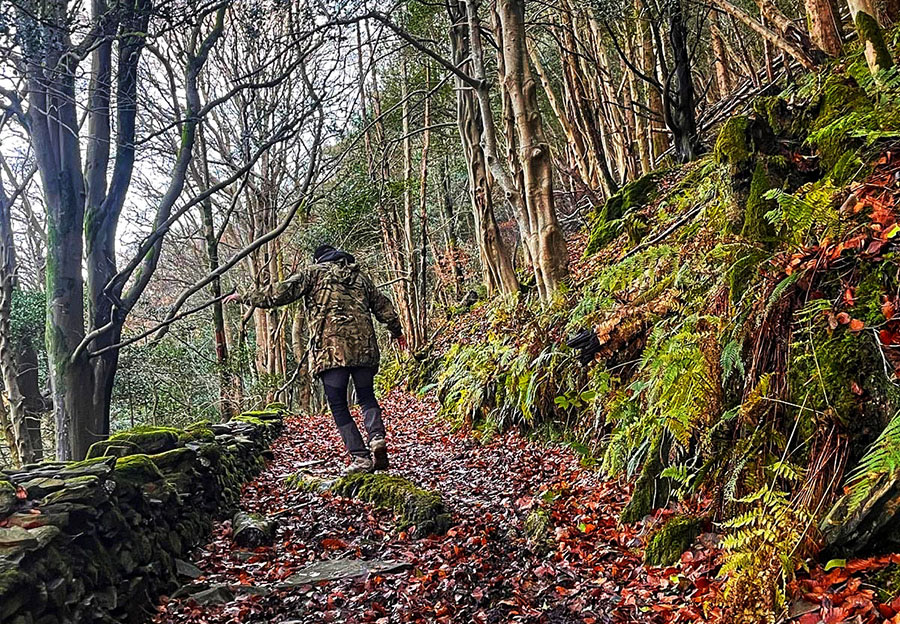
Honestly, this is a big one that has really made a massive difference in my life, so much so that I wrote a book about it. I walk most days. Not for exercise, though it is that too. Not for thinking, though that happens too. I walk because walking is one of the few activities left that can serve no optimised purpose.
Living on the Isle of Man, I am blessed to have access to coastal paths that wind along cliffs, through gorse and heather, past sheep and seabirds. When I walk, I do not listen to podcasts or audiobooks. I do not track my steps or my heart rate. I simply walk.
Thomas Merton wrote, “We are so obsessed with doing that we have no time and no imagination left for being. As a result, men are valued not for what they are but for what they do.” Walking without purpose is a radical practice of being. It is time carved out for no reason other than to exist, to move, to notice.
Sometimes insights come. Sometimes not. That’s not the point. The point is that not everything needs a point. Tell my old self that, and he would laugh. Now, I am well aware of the wisdom that lies within the saunter.
From Having to Being
The psychoanalyst Erich Fromm made a distinction that has stayed with me. In his book To Have or To Be?, he argued that we can exist in two fundamentally different modes. The “having mode” is about acquiring, possessing, controlling, treating everything, including ourselves, as objects to be owned or improved. The “being mode” is about experiencing, relating, expressing, allowing ourselves to simply exist without needing to accumulate or achieve.
Modern life, Fromm argued, has become almost entirely oriented around having. We even speak of “having” experiences, “having” relationships, “having” a life. But you cannot have a life. You can only live one.
Unoptimisation, for me, is partly about this shift from having to being. I am learning to stop treating my own existence as a possession to be polished, a project to be managed, a portfolio to be optimised. Instead, I am trying to inhabit my life, to be present to it rather than always working on it.
This is harder than it sounds. The having mode is deeply ingrained. But every walk without purpose, every morning guarded, every moment of single-tasking is a small practice in being.
Saying No
One of the most powerful tools of unoptimisation is the word ‘no’.
Every invitation, every opportunity, every request is a claim on your time. And time, as Seneca argued two thousand years ago in his letters to Lucilius, is the one resource we squander most carelessly, yet it is the only one we can never recover. Once spent, it is gone.
I have become more deliberate about what I say yes to. Not because I want to be more productive with my remaining time, but because I want to have remaining time. Time to sit. Time to read. Time to be bored. Time to do nothing in particular.
Much better to do fewer things and have time to make the most of them. This is the arithmetic of the unoptimised life. Less, but deeper. Fewer commitments, but real presence in each.
Saying no is difficult. We are trained to see busyness as a virtue and availability as kindness. But there is a deeper kindness in protecting your capacity to show up fully. A hurried yes is often worth less than a considered no.
Embracing the Unfinished
Optimisation culture wants everything complete, polished, perfect. There is no room for the rough draft, the half-formed thought, the project that takes years.
I have been learning to make peace with incompleteness. The article that isn’t quite right. The skill that hasn’t fully developed. The understanding that remains partial.
This is the wisdom of the long game. Some things take time. Mastery takes decades. Wisdom takes a lifetime. Rushing the process doesn’t speed the arrival; it just diminishes the journey.
In my own work, I try to remember this. The book I’m writing doesn’t need to be finished this month. The understanding I’m reaching toward doesn’t need to crystallise today. There is time. There is always time, if I stop pretending there isn’t.
The Body as Teacher
Perhaps the deepest lesson has come from returning to the body.
Modern life is designed to make us forget we have bodies. We sit in chairs, stare at screens, live in our heads. The body becomes a vehicle for carrying the brain from meeting to meeting, a machine to be maintained with the minimum necessary input.
But the body knows things that the thinking mind forgets. It knows when you are tired, when you are pushing too hard, when you need rest. It knows the rhythm of breath, the pleasure of movement, the relief of stillness.
My martial arts practice has always been, for me, a form of embodied philosophy. On the mat, abstract ideas become concrete. You learn patience not by thinking about it but by waiting for the right moment to move. You learn presence not through meditation apps but through the immediate demand of someone trying to submit you.
I have been extending this embodied awareness into the rest of my life. Noticing when my shoulders are tight. Noticing when my breathing is shallow. Noticing when my body is asking for something my thinking mind wants to override.
The body, it turns out, is a reliable guide to unoptimisation. It doesn’t want to be a machine. It wants to move, rest, play, and connect. When I listen to it, I find myself naturally slowing down.
The Quiet Rebellion
None of this is dramatic. There are no manifestos pinned to cathedral doors. No public renunciations of modernity. Just small, daily choices to live a little more slowly, a little more deliberately, a little more humanly.
And yet, in the context of a culture that demands constant acceleration and endless self-improvement, these small choices are quietly radical. Illich wrote that “people feel joy, as opposed to mere pleasure, to the extent that their activities are creative.” To step off the treadmill of self-optimisation, to refuse the ideology that we are projects to be perfected, is to reclaim the possibility of joy.
As Krishnamurti asked in Commentaries on Living, “Is society healthy, that an individual should return to it? Has not society itself helped to make the individual unhealthy?” To unoptimise in a world obsessed with self-improvement is a form of quiet resistance. But it is resistance in the service of something, not just against something. It is resistance in the service of life. Real life. The kind that happens when you stop performing and start being.
An Invitation
I don’t offer this as a program or a system. There are no seven steps to unoptimised living. That would rather defeat the point.
What I offer instead is an invitation. Try, if only for a day, to notice the pull of optimisation in your own life. Notice the pressure to be more efficient, more productive, more improved. And then, gently, refuse.
Carve out a morning. Take a walk without purpose. Do one thing at a time. Say no to something. Let something remain unfinished.
See what happens when you stop treating yourself like a machine, a project to be managed.
See what happens when you remember you are a human being.
We are breath. We are heart. We are story. And most importantly, we are mystery.
And maybe the most radical thing you can do today, right this moment, is not to optimise the next moment, but to be fully here in this very moment.
⎯⎯⎯⎯⎯
Ways to support this work: If you value what’s shared here, you can help keep it free for those who most need it—via a one-off donation [ https://bit.ly/46OFKdu ], a $10/month Patron membership (+ full access to my articles) [ https://bit.ly/4oitQyq ], or by booking a 1:1 Philosophical Coaching session [ https://bit.ly/46OQx7t ]. Your support funds the research and writing.
This resonated deeply with me, thank you for sharing it.
The section on walking without purpose especially stayed with me. I’ve always loved nature walks, but in recent years they’ve shifted from something I did mainly for exercise into something much closer to what you beautifully described as embodied awareness – simply being, noticing, and seeing more clearly.
The emphasis on learning to say no struck a chord too. That quiet reclaiming of time and capacity feels increasingly important.
I also appreciated the Krishnamurti quote – I’ve been listening to his talks recently and find a great deal of resonance in his way of pointing back to direct experience.
A thoughtful and generous piece. 🌿
That's worth reading article
Thanks for sharing and keep writing 💫